
Unlocking the Past: Why QR Code Tombstones Are the Future of Genealogy and Family History
For millions of people around the world, genealogy is more than just a passing hobby—it is a deeply personal quest to understand who we are by uncovering the stories of those who came before us. We spend countless hours combing through digitized census records, deciphering faded handwriting on old military documents, and piecing together branches on digital family trees.
Yet, any seasoned family historian knows that the ultimate, emotional culmination of this research usually happens in a physical space: standing quietly in a cemetery before the headstone of an ancestor.
It is a profound moment of connection. But all too often, that connection hits a brick wall of cold stone. You find the monument, but the engraving offers nothing more than a name, a birth year, and a death year. The decades of triumphs, struggles, migrations, and love stories that defined that ancestor's life remain locked away in private digital folders or buried deep inside online subscription databases.
A traditional headstone marks the physical resting place, but it fails to tell the story. For families looking to ensure their history isn’t lost to time, LifeScanQR offers a revolutionary solution. By integrating weather-resistant QR code technology directly onto tombstones, we can now bridge the gap between physical gravesites and digital family trees, turning static monuments into living, interactive archives for generations to come.
The Genealogy Disconnect: Why Physical Cemeteries Need Digital Context
Cemeteries are the world's most enduring museums of human history, but they are plagued by a severe lack of curation. When a researcher or a distant descendant walks through a historical cemetery, they are surrounded by hundreds of lives, yet they have access to almost none of the data.
Consider the limitations that traditional genealogy faces today:
The "Siloed" Data Problem: Your family history research likely lives inside an app, a private website, or a physical binder at home. When someone visits the actual grave of your great-grandfather, none of that rich historical context travels with them.
The Loss of Oral History: When older generations pass away, their firsthand knowledge of family lineages often goes with them. If those stories aren’t anchored to a permanent physical or digital landmark, they risk fading into obscurity within two generations.
Decaying Gravestones: Over decades, limestone, marble, and sand-blasted text succumb to acid rain, moss, and erosion. Vital historical data literally wears away from the physical stone.
By introducing a LifeScanQR plaque to an ancestral monument, you permanently anchor your family's verified historical record directly to their physical resting place. It ensures that the hard work you’ve put into researching your lineage becomes a permanent, public-facing or private-secured monument of its own.
How LifeScanQR Transforms Cemetery Research and Ancestry Preservation
Integrating QR code technology into family history management transforms how future generations interact with their heritage. Instead of a passive walk through a graveyard, a visit to an ancestor's resting place becomes an immersive, educational journey.
1. Merging the Digital Family Tree with the Physical Grave
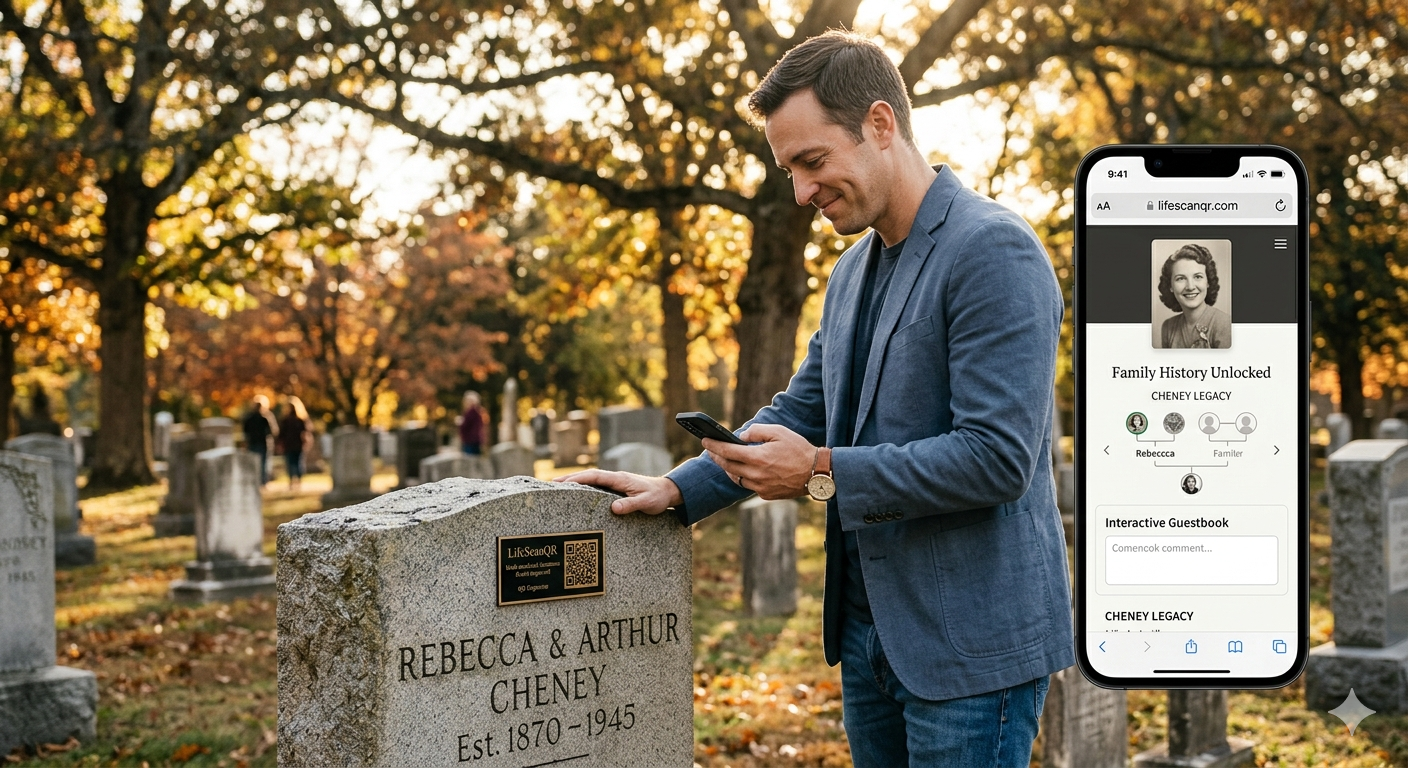
Imagine a great-grandchild visiting an old family plot. By scanning the LifeScanQR plaque on a headstone, they don't just see one name; they instantly view a digital lineage chart. They can see who that person's parents were, where they immigrated from, and how their life connects directly down to the teenager holding the smartphone. It brings a static family tree to life at the exact coordinate where that ancestor rests.
2. Preserving Primary Historical Documents
Genealogists thrive on primary sources—marriage certificates, immigration passenger lists, old newspaper clippings, and military discharge papers. LifeScanQR allows you to upload high-resolution digital copies of these invaluable documents directly to the ancestor’s memorial page. Visitors can read the actual text of a 1918 obituary or look at a scanned image of a homestead land patent right there at the gravesite.
3. Crowdsourcing the Missing Pieces of Your History
One of the most frustrating aspects of family research is hitting a "brick wall"—a point where the paper trail goes cold. LifeScanQR pages feature interactive digital guestbooks and contact features. When distant cousins or local historians discover the grave and scan the code, they can leave comments, upload missing photos from their own private collections, or share stories passed down through their branch of the family. It turns a headstone into a collaborative hub for historical discovery.
The Tech Behind the Tribute: Engineered for Generations
A common hesitation among historians when introducing modern tech to an ancient practice is the question of longevity. Will a digital solution survive the elements as long as granite?
LifeScanQR addresses this head-on by separating the physical hardware from the digital software.
The Hardware: Our memorial plaques are crafted from ultra-durable, weather-tested materials like anodized aluminum. They are designed to withstand extreme UV exposure, sub-zero winters, torrential rain, and the aggressive wear-and-tear of commercial cemetery lawnmowers. They require no batteries, wires, or cellular components to function on the stone itself.
The Software: The QR code links to a cloud-hosted digital profile. As technology evolves from 5G to 6G and beyond, the underlying software adapts automatically. If you ever need to correct a historical date, add a newly discovered photo, or completely rewrite the biography, you can update the digital page instantly from any computer or smartphone—without ever having to alter the physical stone.
Step-by-Step Guide: How to Curate a LifeScanQR Page for an Ancestor
Building a digital memorial for an ancestor is a deeply rewarding project that can be done collaboratively with your living relatives. Here is how to create an authoritative, engaging historical profile:
Map Out the Vital Timeline: Begin your page with a clean, easy-to-read chronological outline. Include birth, marriage, and death dates, along with major historical context (e.g., "Immigrated from Ireland in 1885," "Served in World War II," "Founded the local town bakery in 1920").
Upload the Visual Narrative: Gather any existing photographs. Even if you only have one or two portraits of an early ancestor, include them. If you have photos of their homes, their businesses, or family reunions, add them to a dedicated gallery to provide a sense of the world they lived in.
Include the Paper Trail: Scan and upload PDFs or JPEGs of census records, military drafts, or handwritten letters. This adds a layer of authentic historical credibility that fascinates younger generations and serious researchers alike.
Write a Character-Driven Biography: Move beyond cold facts. Share the stories passed down through family lore—their work ethic, their favorite pastimes, their personality quirks, or the values they instilled in their children.
Affix the Plaque Cleanly: Once your custom LifeScanQR plaque arrives, install it using our industrial-grade, outdoor adhesive. Clean the granite or bronze surface thoroughly with rubbing alcohol, apply the adhesive backing, and press firmly for 60 seconds. The link between past and present is now permanently forged.
An Act of Legacy Stewardship: Leaving a Trail for Those to Come
We often think of genealogy as looking backward, but true family historians know that it is actually a gift meant to be sent forward. We do this work so that the people who occupy the world long after we are gone will know who they are, where they came from, and what kind of blood runs through their veins.
Leaving a cemetery marker un-curated is a missed opportunity. Decades from now, your descendants will visit these same plots. If they find only a bare stone, their connection to that ancestor will remain abstract and distant. But if they find a LifeScanQR plaque, they will be granted immediate access to a rich, cinematic, and profoundly moving portrait of their own heritage.
By upgrading your family monuments with modern QR technology, you aren't just remembering the dead—you are actively protecting history, anchoring truth, and ensuring that your family’s most sacred stories are preserved, accessible, and vibrant for centuries to come.
Ready to Secure Your Family’s History?
Don't let your years of hard genealogy research stay hidden away on a hard drive. Bring your ancestors' stories back to the places where they rest, and ensure that future generations can connect with their roots instantly. Visit www.lifescanqr.com today to choose the perfect, weather-resistant plaque for your family monument and begin building an unbreakable bridge across generations.